SOCIAL MEDIA
Portuguese Medical Association's Scientific Journal

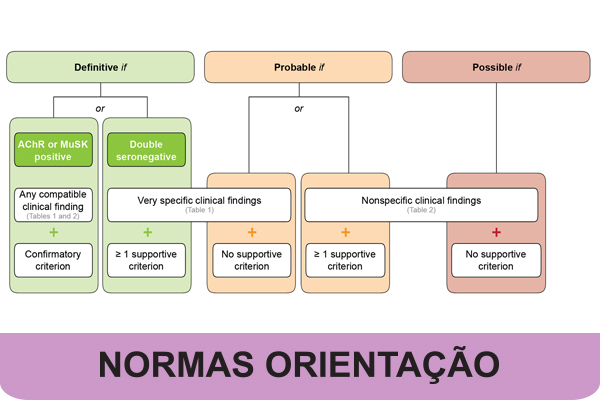
Myasthenia gravis is an autoimmune disease that affects the neuromuscular junction, mainly through the action of pathogenic antibodies such as those directed against the nicotinic acetylcholine receptor or, more infrequently, against the muscle specific kinase. Other important components of the autoimmune process include the complement pathway and B and T cell populations. Diagnosis is based on the finding of fatigable muscle weakness, which can affect several muscle groups, either in isolation or in variable combinations. Neurophysiological techniques and/or the detection of pathogenic antibodies in serum are also essential for the diagnosis of myasthenia gravis. Maintenance treatment was traditionally based on corticosteroids and non-steroidal immunosuppressants. Recently approved drugs, such as the terminal complement pathway inhibitors and the neonatal Fc receptor antagonists, are reshaping the treatment landscape, supported by robust evidence of an excellent combination of efficacy and safety. Although several international guidelines have been published in the last decade, some key questions remain without precise guidance. Hence, a group of nine experts from the Portuguese Neuromuscular Society has elaborated consensus guidelines that aim to provide detailed guidance on diagnostic workup and treatment, grounded both in published evidence and in clinical experience. Key novel aspects include step-by-step instructions for diagnostic workup, a set of diagnostic criteria, guidance on the use of complement inhibitors and neonatal Fc receptor antagonists, and tailored treatment algorithms according to antibody subgroup and clinical severity.