SOCIAL MEDIA
Portuguese Medical Association's Scientific Journal

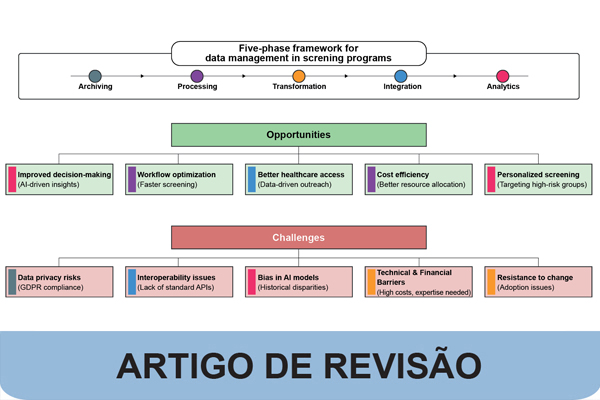
Population-based screening programs are vital public health initiatives that enable the early detection of diseases, significantly reducing both morbidity and healthcare costs. As these programs expand, the management of the extensive data they generate becomes increasingly complex, highlighting the need for structured digital solutions. This narrative review article presents a pragmatic framework aimed at clarifying big data analytics tailored to the needs and practices of healthcare professionals and administrators, focusing on effective integration into routine screening workflows. To achieve effective data utilization, the process begins with systematic archiving, which involves cloud-based storage solutions capable of securely maintaining various data formats in compliance with regulatory standards, thus ensuring long-term accessibility and continuity. Subsequent real-time processing of screening data facilitates rapid decision-making and patient management by providing immediate validation and analysis, essential for maintaining the responsiveness of screening services. Transformation processes play a critical role in converting diverse data inputs into standardized, consistent formats, enabling seamless communication and exchange among multiple healthcare systems. Integration further builds upon this standardization, merging data from different healthcare providers and diagnostic centers into centralized analytical platforms. This unified approach enables comprehensive patient monitoring and supports predictive modeling for early identification of at-risk individuals. Advanced analytics, particularly process mining and predictive techniques, reveal inefficiencies within screening workflows, highlighting areas needing improvement. These methods help healthcare managers to streamline operations, optimize resources, and enhance overall program performance. Real-time visualization tools provide administrators with continuous, practical insights into operational dynamics, despite existing challenges related to data governance and system interoperability. This article illustrates these concepts through concrete examples from the colorectal cancer screening program in Northern Portugal and the response to the COVID-19 pandemic. The colorectal cancer screening scenario demonstrates how structured data management significantly boosts operational efficiency and healthcare accessibility. Meanwhile, the COVID-19 experience highlights the importance of having flexible digital infrastructures capable of quickly adapting to unexpected crises. Finally, ongoing investments in digital infrastructure, professional training, and comprehensive data governance are crucial for sustaining these improvements. This review provides clear, actionable knowledge to support healthcare professionals in adopting big data analytics effectively within preventive healthcare programs.